


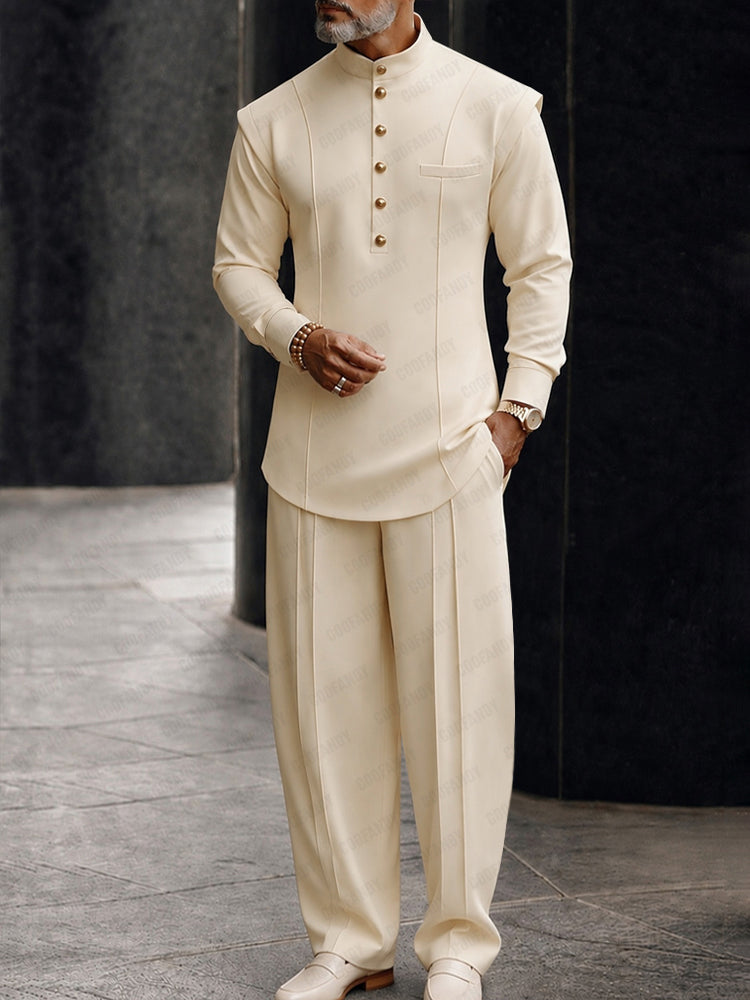


How to Mix Fall Textures Without Looking Busy

Mix fall textures by choosing one garment as the visual anchor and making the others quieter in scale, color or surface. Pair pronounced corduroy or chunky knitwear with smoother cotton, fine knits or clean trousers. Two or three textures can work together when their visual weights differ and the silhouette stays simple.
TL;DR
- Choose one dominant texture before adding another.
- Vary visual scale: bold ribs or cables need calmer supporting surfaces.
- Reduce color and pattern when texture is already strong.
- Check the outfit from conversation distance, not only close up.
Decision Matrix
| Texture | Visual weight | Best supporting surface | Color risk | Useful role |
|---|---|---|---|---|
| Chunky knit | High | Smooth shirt or clean trousers | Several heathered colors compete | Mid-layer anchor |
| Corduroy | Medium to high | Fine knit or plain woven shirt | Deep ribs intensify saturated color | Pants, overshirt or jacket anchor |
| Denim | Medium | Soft knit or crisp cotton | Heavy fading adds another pattern | Casual foundation |
| Tweed-like surface | High | Solid fine knit or smooth trousers | Multicolor flecks can crowd accessories | Structured outer anchor |
| Fine knit | Low to medium | Can support corduroy, denim or tailoring | Low risk in a solid color | Bridge texture |
1. Name What the Eye Sees
Texture is the visible surface of a garment: ribs, loops, grain, nap, slub or a smooth weave. It affects how light and color appear. Begin by describing each piece as quiet, medium or pronounced. This practical scale is more useful for styling than memorizing technical fabric terms.
2. Choose One Anchor

Let one garment carry the strongest texture. Corduroy pants, a cable sweater or a textured blazer can each lead, but using all three at equal strength makes the outfit harder to read. The corduroy outfit guide handles that fabric in depth; here, corduroy is one example in a broader balancing method.
3. Add a Bridge Texture

A fine knit, smooth button-down or clean pair of trousers can connect two more visible surfaces. The bridge is not necessarily flat or boring; it simply creates less contrast at normal distance. Repeat one color family between the anchor and bridge so texture, rather than several unrelated colors, does the work.
4. Control Pattern and Silhouette
Texture already behaves like a low-level pattern. If the anchor also has a check, stripe or marled color, reduce pattern elsewhere. Keep the silhouette clear: one relaxed piece may balance with straighter supporting pieces, while several oversized, heavy textures can obscure proportion.
5. Use the Conversation-Distance Test

Stand several feet from the mirror or take a neutral photo. If every garment attracts attention at once, remove one texture, simplify a color or replace a pattern. If the outfit looks flat, add one surface with a different scale. For palette decisions, use the fall color guide.
Four Controlled Pairings
- Corduroy pants, a smooth Oxford shirt and a fine crewneck.
- A chunky cardigan, a plain tee and clean dark denim.
- Let the Coofandy Trendy Solid Tweed Blazer be the textured anchor, paired with a solid fine knit and smooth trousers.
- A denim overshirt, a soft knit polo and chinos.
These are formulas, not claims about a particular product's fiber, warmth or durability.
Scope of This Guide
The method distinguishes visible texture, scale, color and silhouette. Recommendations are editorial styling judgments and do not infer technical fabric performance.
Frequently Asked Questions
How do men mix textures in an outfit?
Choose one dominant texture, add a quieter bridge surface and keep color or pattern restrained. Compare the visual scale of each garment from several feet away. Corduroy or chunky knitwear can lead; smooth cotton, fine knit or clean trousers can support. If every piece demands attention, simplify one of them.
How many textures can men wear at once?
Two or three visible textures can work, but the useful limit depends on their scale and color. One should lead while the others support. Three bold textures in saturated colors are harder to balance than corduroy, a fine knit and smooth trousers. Treat clarity, not a fixed count, as the rule.
Can you wear corduroy and knitwear together?
Yes. Pair pronounced corduroy with a finer, quieter knit, or use a chunky knit with corduroy whose ribs and color read more calmly. Keep the shirt, footwear and accessories restrained. The pairing becomes busy when both textures are bold and several additional patterns or strong colors compete with them.
Related Reading
- Corduroy Outfits for Men: A Fall Texture Guide
- Fall Colors for Men: Oatmeal, Brown, Burgundy & Olive
- Men's Fall Outfits: The Complete 2026 Style Guide
About COOFANDY
Founded in 2015, COOFANDY is a menswear brand created for modern men navigating work, weekends, celebrations, and everyday life. Its collection includes shirts, suits, pants, sweaters, and tees designed to help men build versatile, confident looks for different moments and personal styles. Guided by the belief that clothing can reflect confidence and character, COOFANDY focuses on making approachable menswear part of every stage of life.

Leave a comment