




How to Judge a Premium Men's Shirt Online
To judge a premium men's shirt online, look for information you can check, not just a persuasive label. Start with the listed fiber content and care instructions, compare the size information with a shirt you own, and inspect clear front, back, and detail photos. If a measurement or view you need is missing, treat it as unknown. An attractive photograph can help you assess a design; it cannot tell you how the cloth feels or how the shirt will wear after repeated washing.
This is a decision about evidence, not about finding a universal definition of “premium.” The most useful listing is one that lets you test whether the shirt suits your occasion, your body, and the way you care for clothes. Three questions keep the search manageable: What does the page actually specify? What can I compare with a shirt I know? What remains unverified?
Start With the Facts a Listing Can Confirm
Read the composition as a fact about the fibers listed for that particular shirt. Then read the care label or care instructions. A fiber name alone does not establish how a finished shirt will feel, whether it will wrinkle to your liking, or how it will perform in your climate. If a listing uses words such as “soft,” “breathable,” or “easy care,” look for an explanation tied to that garment rather than assuming the adjectives are measurable promises.
Check whether the page identifies the shirt's intended shape, collar, sleeve length, and hem. Those details affect how you would wear it: an open collar and untucked hem may answer a different occasion from a shirt meant to sit neatly beneath a jacket. This is about matching the visible design to your use, not ranking one collar or fabric above another. Price can affect your budget, but a higher price or a “premium” name is not evidence of a particular seam treatment or a better fit.

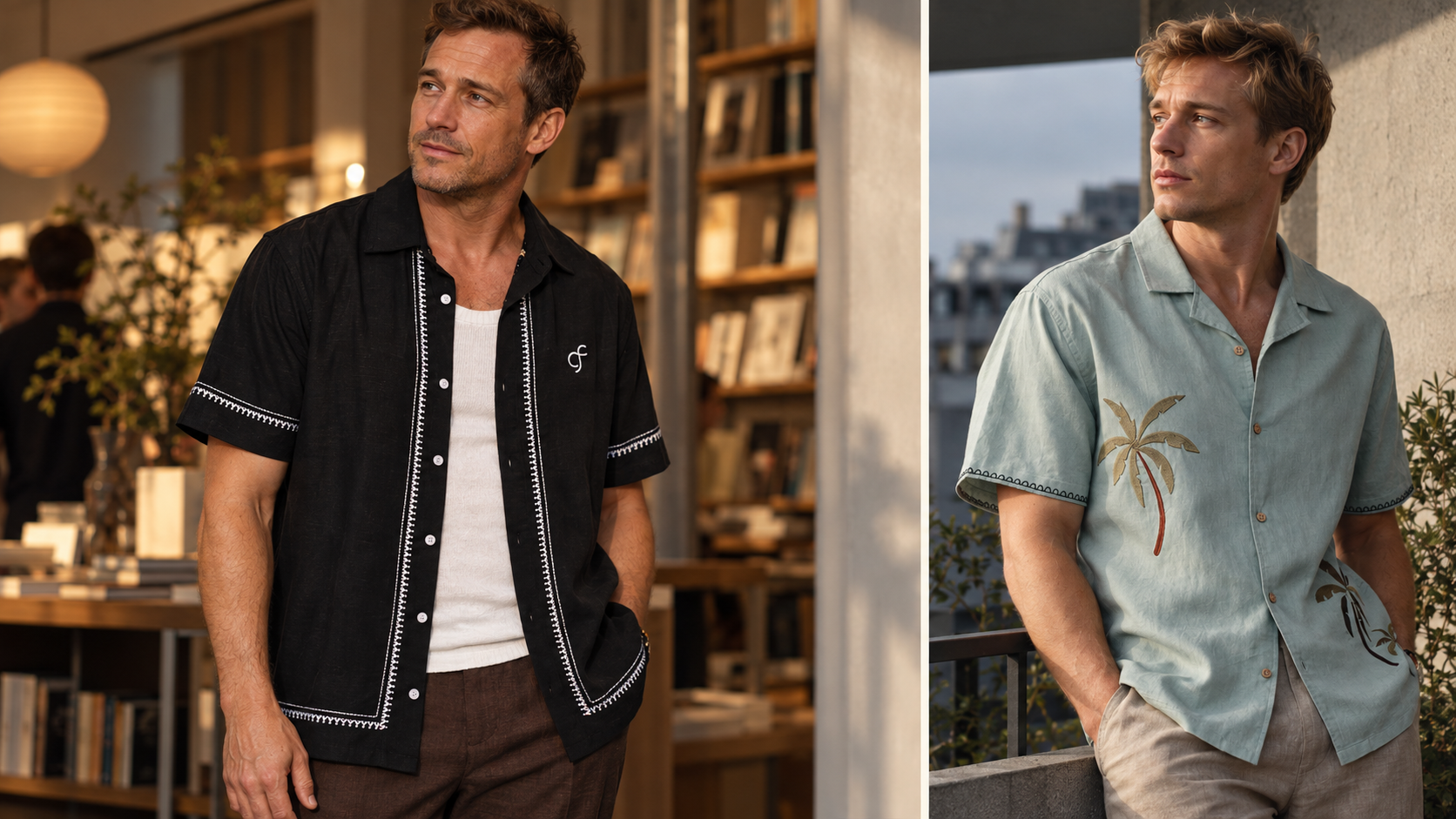
Look at the complete set of images, not only the styled first photograph. A close-up may show a texture; a full front and back can show proportions and the way the sample hangs. Lighting, styling, and the model's size can change your impression. If the page does not give a fabric close-up, a back view, or care information, note exactly what is absent rather than filling the gap with an assumption. You can still like the design while deciding that the available evidence is incomplete.
Compare Fit With a Shirt You Own
Lay a shirt you already wear well flat and measure it consistently. Note the chest across the underarms, shoulder width, sleeve length, and body length. Take the same measurements from a less successful shirt if you have one; the difference can reveal whether you need more room in the chest or a shorter body, rather than simply a different size label. Use a flexible tape and keep the garment flat without stretching it.
Next, check what the online chart measures. A body-size chart describes the wearer; a garment chart describes the finished shirt. Do not compare a shirt's flat chest width directly with your body circumference as though they were the same number. If the listing explains its measuring method, follow it. If it does not, ask whether the measurements are for the garment or for the person, and whether the chest number is taken flat or around the body.
Compare like with like. If your reference shirt is measured flat, compare it with published flat garment dimensions in the same unit. A labeled “regular fit” may be useful context, but it is not a substitute for chest and shoulder figures. Think about the activity: a shirt worn under a blazer needs a different visual relationship at the shoulders and sleeves from a loose shirt worn open on vacation. Leave room for movement and layering according to how you actually wear your reference shirt; do not assume that a model image shows your proportions.
If the chart omits a dimension important to you, the honest result is “I do not know yet.” Ask for the missing garment measurement before picking between sizes. A return policy may help you manage uncertainty, but it does not turn incomplete fit information into a reliable measurement.
Read the Photos, Then Mark the Unknowns
For a collared shirt, zoom in on the collar points and how the collar sits at the neck. Look at the placket, button spacing, cuffs, and hem. Full-length views can show whether the chest pulls on the photographed model, how long the shirt appears relative to the trousers, and whether a pattern continues at a visible seam. A rear view can answer questions a front-only image cannot. These are observations about the photographed sample, not guarantees that every size will hang identically.

Look for clear images of stitching, pocket placement, and the inside of the collar or cuffs if the listing provides them. A straight-looking line in a photo may be reassuring as a visible detail, but a photograph cannot confirm thread strength, hidden seam construction, button security, or long-term durability. It also cannot tell you whether a fabric feels scratchy, how it responds to your movement, or whether a collar remains comfortable throughout a day. Do not invent an unseen construction method from a polished product shot.
Separate “visible,” “specified,” and “unknown” as you browse. Fiber content may be specified in text; a seam or texture may be visible; hand feel is usually unknown until you handle the shirt. Reviews may describe one person's experience, but check which size and use they refer to before applying them to yourself. If a detail matters enough to change your decision, ask the seller for a precise photograph, measurement, or care instruction. A generic reply that repeats “high quality” does not answer a concrete question.
Put the Checklist to Work
Shortlist a shirt when the listed composition and care suit your needs, comparable measurements support the intended fit, and the visible details answer your design questions. Ask for information when one missing measurement or view is the only obstacle. For example, request the garment's flat chest width in your intended size; a reply giving only the model's height does not resolve that fit question. Skip a listing when the essential facts remain unavailable or conflict with your requirements. You do not have to settle a question about hidden construction by guessing from the price.
Apply the checklist to our Soft Touch Linen Blend Shirt: compare the listed size and care information with your needs, and check the available photos before deciding.
COOFANDY Signature is COOFANDY's premium menswear collection, with fabric, fit, and finishing details as its design focus. That makes the same checklist relevant when you explore it, but the collection name does not certify an individual shirt. Use the COOFANDY Signature page for the collection's direction and the COOFANDY Signature collection to browse its listed assortment. Check each garment's own details before deciding whether it belongs on your shortlist.
FAQ
Can photos prove that a shirt is well made?
No. Clear photos can help you inspect visible features such as the collar, placket, cuffs, seams, and overall shape. They cannot establish hidden construction, how the fabric feels, or how the shirt will hold up with wear and care. Ask for a specific missing view or detail if it matters to your decision.
Is a premium label enough to judge shirt quality online?
No. Treat it as positioning, then check the garment's listed composition and care, compare its measurements with a shirt you own, and examine the available photographs. If information essential to your choice is missing, ask for it or move on rather than assuming the label supplies the answer.

Deixe um comentário